
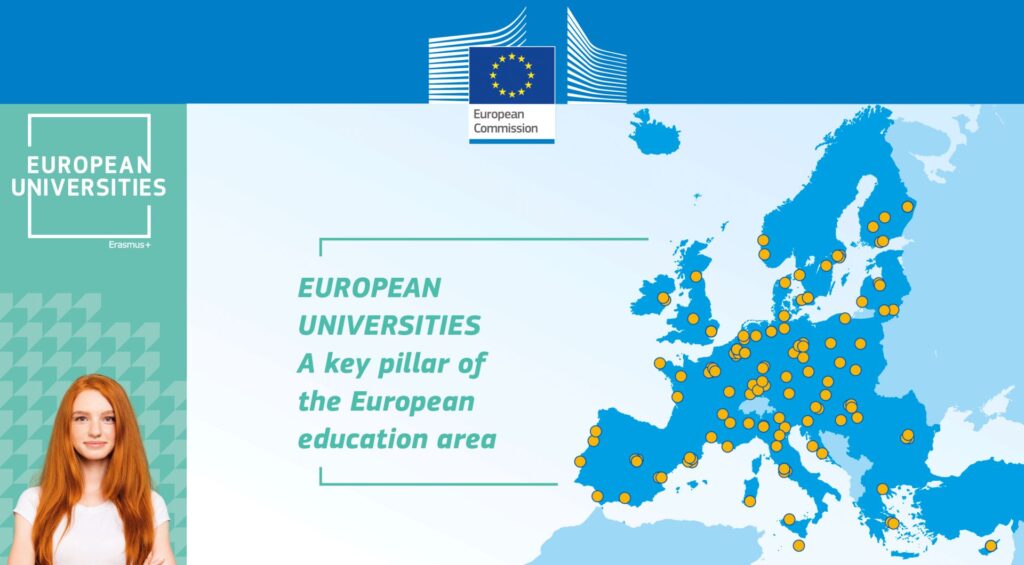
Ukraine’s Participation in the European Universities Alliances Initiative of the EU Erasmus+ Programme in 2022–2026
The National Erasmus+ Office in Ukraine has prepared information on Ukraine’s participation in the European Universities Alliances initiative of the EU Erasmus+ Programme in 2022–2026, with the aim of sharing the experience of Ukrainian universities in such alliances.
This ambitious EU initiative is aimed at creating alliances between higher education institutions from across Europe for the benefit of their students, staff and society. These transnational partnerships seek to radically enhance the quality, attractiveness and international competitiveness of European higher education, as well as to create “universities of the future” and promote European values and identity.
European universities learn from each other, building on the experience and culture of each institution, on how to cooperate and compete together at international level and address global challenges.
Main objectives and principles of the initiative
The main task of the initiative is to remove administrative barriers to ensure seamless mobility and cooperation (the so-called “fifth freedom” of the EU: the freedom to study, teach and conduct research).
- Integrated university campuses: Students, academic staff and researchers can move flexibly between partner universities, both physically and virtually. The aim is to reach at least 50% of alliance students through such mobility.
- Joint degrees: Alliances develop innovative study programmes leading to joint European-style degrees (European Degrees).
- Pooling expertise: Universities share resources, laboratories and research capacity to address global challenges such as the green and digital transitions.
- Regional development: In addition to universities, more than 2,200 associated partners (municipalities, civil society organisations, businesses) are involved in the consortia to support the development of local communities.
The initiative was launched in 2017: French President Emmanuel Macron first proposed creating a network of European universities during his famous Sorbonne speech. The European Commission and the European Council quickly supported this vision.
In 2019, the European Commission officially launched EU Erasmus+ Programme calls, as a result of which the first 17 alliances began implementing pilot projects.
As this initiative was not open to Ukraine, the Ministry of Education and Science of Ukraine, in cooperation with the NEO in Ukraine, submitted a request to the European Commission regarding the possibility of Ukraine joining the initiative.
Meanwhile, the AURORA Alliance invited V. N. Karazin Kharkiv National University to cooperate with the Alliance, and its team was the first to join the activities of the flagship initiative of the alliances, even before participating in this Erasmus+ call.
In 2022–2026, the Ministry of Education and Science of Ukraine, the NEO in Ukraine, the Union of Rectors and Ukrainian universities addressed the European Commission and the alliances regarding the involvement of Ukrainian institutions in the alliances and opportunities to participate as equal partners in such Erasmus+ calls.
Following Russia’s full-scale invasion of Ukraine, the Alliances joined forces in their efforts to support Ukrainian universities and initiated Twinning Partnerships to involve them in the alliances. A number of joint statements in support of Ukraine were prepared, and the alliances intensified their efforts to attract additional funding (for example, through complementarity with Erasmus+ mobility and cooperation projects, Horizon Europe, NAWA – support for Ukraine, and other local and sectoral initiatives).
Thus, within the 2022–2026 calls, universities and other organisations from Ukraine were given the opportunity to participate in the Alliances calls as associated partners, i.e. without funding, but with the opportunity to contribute to strategic planning, thematic working groups and sectoral alliances, decision-making, the co-design of educational programmes and joint Master’s programmes, participation in European Student Card, European Degree and European Label initiatives and other activities, as well as to have access to campuses and resources (interuniversity campuses).
The Alliances, together with the European Commission, the European University Association, the European Association for International Education, the Ministry of Education and Science of Ukraine, the Ukrainian Centre for International Education, the NEO in Ukraine and Ukrainian universities, conduct, publish and disseminate research, organise conferences, exhibitions and special sessions on the situation in Ukraine, its higher education system, its resilience and the resilience of Ukrainian institutions during Russia’s war against Ukraine. They help disseminate “quiet diplomacy” practices through initiatives such as Unissued Diplomas, burnt school textbook libraries and others. They organise summer/winter schools for university students and staff, build innovative capacity and exchange good practices. They actively participate in various Erasmus+, Horizon Europe, DAAD, NAWA and other initiatives and calls. They provide humanitarian and other assistance.
They also organise meetings with the European Commission, at the European Parliament, the Council of Europe and at other levels.
Even without funding, most universities in the alliances are very active players, as they understand the importance of building a common future in the European Education Area together.
In 2022–2026, within the calls, 37 alliances involved 41 Ukrainian universities, an institute for professional development and a city council as associated project partners.
In the 2026 call, among the 5 funded alliances, which involve 9 Ukrainian higher education institutions, 6 institutions joined as newcomers. Some alliances received funding to continue their activities.
Currently, there are 73 active alliances bringing together almost 650 higher education institutions from across Europe and beyond.
4 Ukrainian universities are involved in 14 alliances: Taras Shevchenko National University of Kyiv is involved in 5 alliances (ARTEMIS, EU GREEN & EU Green 2, EUniWellWeFF, UNIC, STARS EU), while three alliances each involve the National University of Kyiv-Mohyla Academy (EUPeace, ARQUS & ARQUS BRIDGE, NEOLAiA), Sumy State University (E3UDRES2 2.0, FilmEU Plus, NEOLAiA), and Yuriy Fedkovych Chernivtsi National University (STARS EU, UNITA, NEOLAiA), while 8 universities are involved in 2 alliances each.
The list of alliances, Ukrainian participants, coordinators and resources on their websites is available on the NEO in Ukraine website under Projects in Ukraine – Project Database – Results of the 2021–2026 calls.
The presentation on Ukraine’s participation (in English), available in the section on calls for the alliances initiative, may also be useful.
A meeting of Ukrainian participants in the alliances is planned for October 2026 as part of Erasmus Days 2026 in Ukraine. Follow the announcements on the NEO – Ukraine website for registration and participation.
Warm congratulations to the winning teams from the entire Erasmus Community, and we invite other institutions to join!