
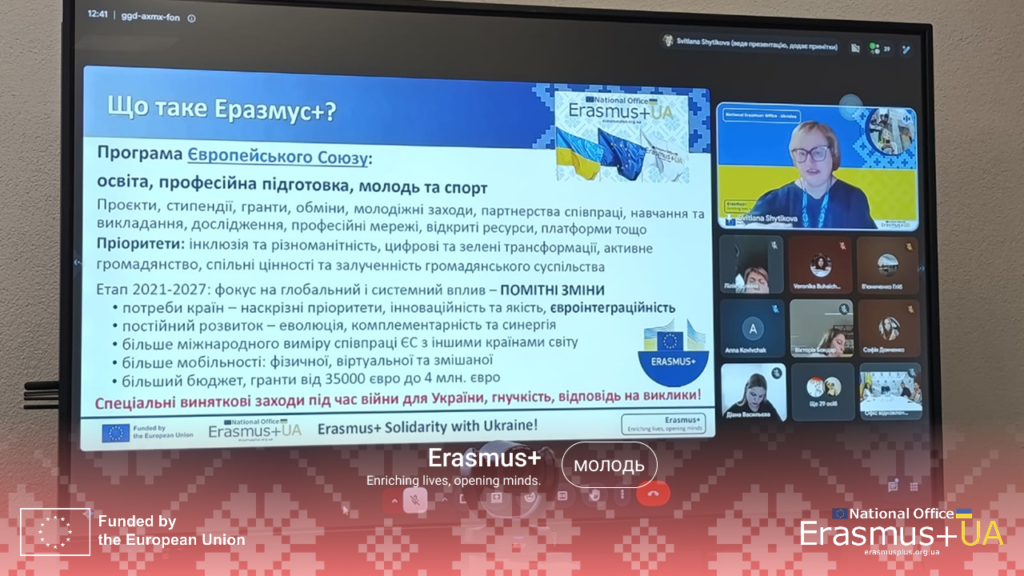
On 16 October 2026, the team of the National Erasmus+ Office – Ukraine took part in a seminar for youth advisers in Donetsk Region. The event was held in a hybrid format and chaired by Oleksandr Shevchenko, Deputy Head of the Donetsk Regional State Administration. It focused on the development of youth policy, strengthening the […]
On 15 October 2026, from 12:00 to 14:30, as part of ErasmusDays2026, the National Erasmus+ Office in Ukraine team invites you to participate in the cluster webinar for associated partners of European Universities Alliances (institutional Erasmus+ coordinators responsible for international cooperation of higher education institution staff) and Follow-up to the participation of Ukrainian universities in […]

On 17 November 2026, the long-term training course “Advanced Training on Advocacy and Lobbying for International Youth Work” will start, focusing on advocacy and lobbying for youth cooperation between the European Union and its neighbouring partner countries. The first online workshop will take place on 17 November 2026. The residential seminar is scheduled for 15-20 […]

On 7 October 2026, the ASEM Online Seminar “Beyond Degrees: Mapping Skills with AI across Asia and Europe” will take place, focusing on the use of artificial intelligence to identify and map skills and competences beyond traditional degrees. The seminar will bring together higher education experts from Asia and Europe to explore the potential of […]
The National Erasmus+ Office in Ukraine invites implementers and participants of CBY, CBS and KA220 projects selected under the 2026 call to a webinar on 16 October 2026 within ErasmusDays2026 in Ukraine. The event will focus on specific features of CBY, CBS and KA220 projects implementation, synergy and interaction with other projects and initiatives under […]
The National Erasmus+ Office – Ukraine invites implementers and participants of CBVET and KA220 projects selected under the 2026 call to an online webinar on 15 October 2026 within ErasmusDays2026 in Ukraine. The event will focus on specific features of CBVET and KA220 projects implementation, synergy and interaction with other projects and initiatives under the […]
The National Erasmus+ Office in Ukraine invites implementers and participants of CBHE and KA220 projects selected under the 2026 calls for proposals to a webinar on 14 October 2026 within ErasmusDays2026 in Ukraine. The event will focus on specific features of CBHE and KA220 projects implementation, synergy and interaction with other projects and initiatives under […]
The National Erasmus+ Office in Ukraine invites implementers and participants of Jean Monnet projects selected under the 2026 calls to a webinar on October 13, 2026 within ErasmusDays2026 in Ukraine. The event will focus on specific features of Jean Monnet projects implementation under the martial law in Ukraine. Events within the ErasmusDays2026 in Ukraine are […]
12 October 2026, 14:00-17:00. The National Erasmus+ Office in Ukraine invites education institutions, youth and other organizations to participate in a webinar within ErasmusDays2026 in Ukraine “#ErasmusWinnersDay for institutional Erasmus+ coordinators, staff responsible for international cooperation and representatives of Erasmus+ projects-winners in the fields of Education, Training, Youth and Sport: specific features of projects implementation […]