
International Winter School “Challenges for Ukrainian agri-food sector within the European Green Deal”” within the Erasmus+ Jean Monnet Module “European Green Deal: From Theory to Practice in the Agri-Food Sector of Ukraine” (12.06.2026, online)
On 12 January 2026, the National University of Life and Environmental Sciences of Ukraine (NUBIP) launched the International Winter School ‘Challenges for Ukrainian agri-food sector within the European Green Deal”’ – 101176557 – EGDUA – ERASMUS-JMO-2024-HEI-TCH-RSCH, which will run until 6 February 2026.
The event is supported by the European Union’s Erasmus+ Programme (Jean Monnet Action). The winter school is organised by the National University of Life and Environmental Sciences of Ukraine in cooperation with the Leibniz Institute for Agricultural Development in Transition Economies (Germany) and the Latvian University of Life Sciences and Technologies (Latvia).
The winter school aims to create an interdisciplinary educational space in which to discuss the current challenges and opportunities of implementing the European Green Deal’s provisions in Ukraine’s agri-food sector. A total of 476 people joined the winter school, including government body representatives, businesspeople, scientists, civil society members, students and anyone interested in European integration issues and the implementation of the European Green Deal in Ukraine.
The winter school programme focuses on the following key areas: The economic and environmental assessment of the EU and Ukrainian agri-food sectors in the context of the requirements of the European Green Deal; the new EU Common Agricultural Policy (CAP): lessons and opportunities for Ukrainian agricultural producers; carbon farming as a tool for achieving climate neutrality, increasing competitiveness, and improving the economic and environmental efficiency of agricultural production.
The following speakers addressed the participants of the winter school ‘Challenges for Ukrainian agri-food sector within the European Green Deal’: Vadym TKACHUK, Doctor of Economics, Professor, Rector of the National University of Life and Environmental Sciences of Ukraine, and Petro KRAINIK, Project manager for Jean Monnet Actions at the National Erasmus+ Office in Ukraine (EU funded project).
A representative of the NEO – Ukraine spoke about the relevance of the School’s theme in the context of Ukraine’s European integration and the implementation of the European Green Deal tasks as a new European growth strategy, which recognizes the key role of schools, educational institutions, and universities in engaging with students, parents, and the wider public regarding the changes necessary for a successful transition to climate neutrality by 2050, about one of the key priorities of the EU Erasmus+ Program “Environment and Fight Against Climate Change”, and about the opportunities of the Program in various areas, including the Jean Monnet Actions.
The moderator of the first week of the winter school was Ph.D., Associate Professor of the Department of Administrative Management and Foreign Economic Activity at the National University of Life and Environmental Sciences of Ukraine, coordinator of the Jean Monnet Module project “European Green Deal: From Theory to Practice in the Agri-Food Sector of Ukraine” – 101176557 – EGDUA – ERASMUS-JMO-2024-HEI-TCH-RSCH Oleksandr FAICHUK.
The key speakers during the first week of the Winter School were: Oleksandr LABENKO, Doctor of Economics, Associate Professor and Vice-Rector for Scientific and Pedagogical Work and International Activities at the National University of Life and Environmental Sciences of Ukraine; Maksym HOPKA, postgraduate student at the Department of Administrative Management and Foreign Economic Activity at the National University of Life and Environmental Sciences of Ukraine and analyst at the Ukrainian Agribusiness Club Association; Yevhen BEREZHNYAK, PhD in Agricultural Sciences and Associate Professor at the Department of Agrosphere Ecology and Environmental Control at the National University of Life and Environmental Sciences of Ukraine; Vita STROKAL, PhD in Agricultural Sciences and Associate Professor at the Department of Agrosphere Ecology and Ecological Control at the National University of Life and Environmental Sciences of Ukraine; Oleksandr FAICHUK, PhD in Economics and Associate Professor at the Department of Administrative Management and Foreign Economic Activity at the National University of Life and Environmental Sciences of Ukraine; and Bohdan ZVARUN, postgraduate student at the Department of Administrative Management and Foreign Economic Activity at the National University of Life and Environmental Sciences of Ukraine, and a lawyer and the managing director of Zvarun Law Firm.
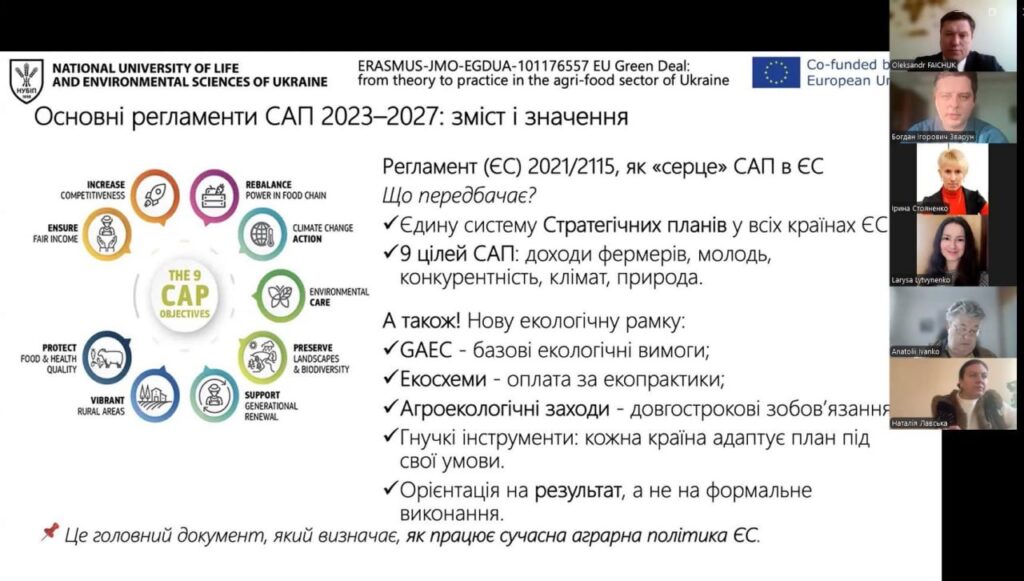
The speakers focused on topical issues such as the key objectives of the European Green Deal (EGD) for the agricultural sector, methods of assessing the economic sustainability of the agri-food sector, the economic development of the agri-food sector in the EU and Ukraine in the context of EGD implementation, the importance of soil for the agro-industrial complex, the challenges of water scarcity for agribusiness, biodiversity and ecosystem services, climate risks and adaptation strategies, the legal basis for planning and financing the EU’s Common Agricultural Policy for the period 2023–2027, and the regulatory and legal aspects of crop and livestock farming within the framework of EGD implementation and EU food law.
Additional information: Contact person from NUBiP: Oleksandr FAICHUK – project manager
More about the project: https://nubip.edu.ua/european-green-deal-theory-practice-agri-food-sector-ukraine-yevropeyska-zelena-uhoda-vid-teoriyi-0
Facebook: https://www.facebook.com/eugreendealua LinkedIn:https://www.linkedin.com/company/european-green-deal