
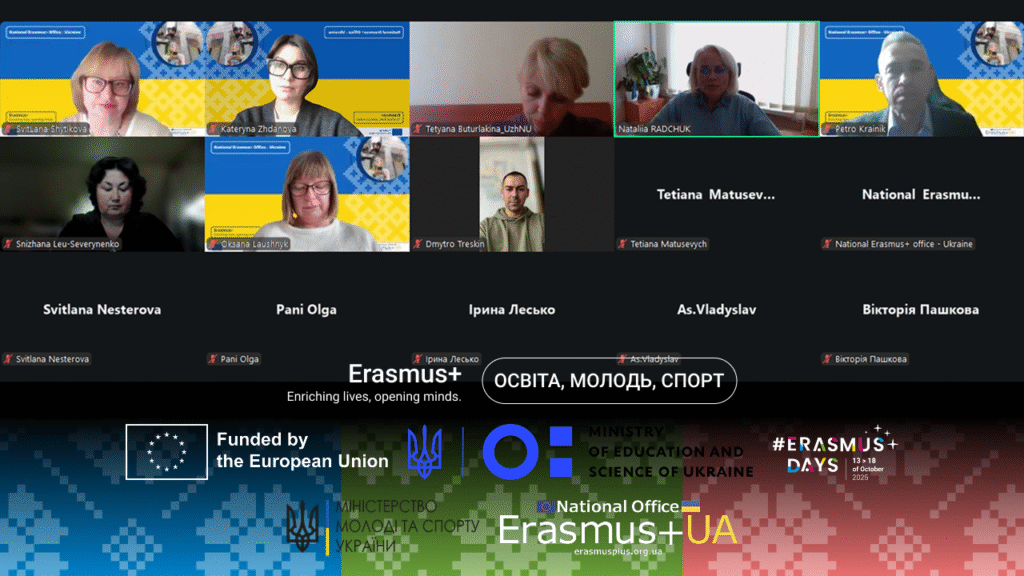
Seminar #ErasmusWinnersDay for Erasmus+ 2025 call project teams in the fields of education, vocational training, youth and sport: specifics of projects’ implementation under martial law in Ukraine (13.10.2025)
On October 13, 2025, as part of the nationwide #ErasmusDays2025, the National Erasmus+ Office in Ukraine team hosted the online webinar: “#ErasmusWinnersDay for Winning Project Teams in in the fields of education, vocational training, youth and sport: specifics of projects’ implementation under martial law in Ukraine.” Activities within #ErasmusDays2025 are organized by NEO in Ukraine in collaboration with and supported by various co-organizers (details are available in the #ErasmusDays2025 concept description).
The event was attended by about 30 representatives from Ukrainian coordinating organizations and beneficiaries, including heads of institutions and project teams from educational, youth, and other organizations either launching or currently implementing EU Erasmus+ projects.
During the session, participants received practical information regarding the implementation of Erasmus+ projects in the fields of education, youth, and sport under the conditions of martial law in Ukraine. Specifically, they explored the following key aspects:
-
Implementation guidelines in accordance with the Erasmus+ Programme Guide, grant agreements, and national legislation under martial law.
-
Strategies for effective project management at all implementation stages during the period of martial law.
-
Procedures for registering International Technical Assistance (ITA) projects, including required stages, deadlines, and the necessary document package.
-
Preparation of monitoring cards and for ex-post audits to ensure proper documentation of implementation and achievement of results.
-
Guidelines for the procurement of goods and services under the current legal framework of martial law in Ukraine.
AGENDA – download.
The participants were welcomed by: Henrik WITFELT, Head of Section for Public Finance, Business Support, and Social Policy at the EU Delegation to Ukraine; Adrian OLSZAK-OLSZEWSKI, Policy Officer at the Directorate-General for Education, Youth, Sport, and Culture (DG EAC) of the European Commission; Natalia RADCHUK, Head of the International Cooperation and European Integration Department of the Ministry of Youth and Sports; and Maryna MRUHA, Head of the Expert Group on Integration into the EHEA and Quality Assurance at the Ministry of Education and Science of Ukraine, HERE team expert..
Svitlana SHYTIKOVA, Coordinator of NEO in Ukraine, opened the first session by addressing the specifics of implementing cooperation and capacity-building projects under martial law. She detailed the importance of role distribution within a project and maintaining clear communication with the Project Coordinator and EACEA Project Officer. Participants were guided through the steps of using the project’s online portal for management and reporting. A comprehensive overview of regulatory documents was provided to ensure Erasmus+ projects in education, youth, and sport align with both Programme rules and Ukrainian legislation. Following this, Oksana LAUSHNYK, Financial Manager of NEO – Ukraine, presented “Grant Fund Management Under Martial Law,” covering various financial management cases for both public institutions and private/non-governmental organizations.
The second part focused on the practical aspects of state registration for international projects in Ukraine. Veronika IVANOVA, Petro KRAINIK, and Kateryna ZHDANOVA, Managers of NEO – Ukraine, provided a step-by-step guide on preparing and submitting document packages to the Secretariat of the Cabinet of Ministers of Ukraine. Key topics covered included: proper formatting of support letters, budget tables, and requests; common mistakes made by applicants during document preparation; timelines for application reviews; procedures for re-registration in cases of project extensions or partnership changes.
Svitlana SHYTIKOVA and Kateryna ZHDANOVA led the third session on effective communication and project synergy. They emphasized that Erasmus+ is not just about project activities but about creating “success stories” and added value for target groups. Strategic recommendations included:
-
Visual Tools: infographics, videos, and social media while adhering to EU visual identity requirements and visibility rules.
-
Synergy: Scaling results by joining forces with other projects and teams to achieve a wider impact.
-
Multimedia Formats: Using exhibitions, roundtables, and live broadcasts to showcase participant stories and practical outcomes.
The event concluded with a Q&A session where the NEO – Ukraine team provided expert clarifications based on real-life cases, specifically regarding state registration and reporting challenges. The team reaffirmed their commitment to supporting Ukrainian organizations in the successful implementation of Erasmus+ initiatives.
SPEAKERS’ PRESENTATIONS AND USEFUL MATERIALS:
- “Specifics of Implementing Cooperation and Capacity Building Projects in Education, Youth, and Sport under Martial Law” – Svitlana SHYTIKOVA, NEO – Ukraine
- “Specifics of Grant Management under Martial Law” – Oksana LAUSHNYK, NEO – Ukraine
- “Specifics of State Registration of Projects in Education, Youth, and Sport as International Technical Assistance at the Secretariat of the Cabinet of Ministers of Ukraine” – Veronika IVANOVA, Petro KRAINIK, Kateryna ZHDANOVA, NEO – Ukraine
- Grant Management Portal
- Pamyatka: Methodological Recommendations for Erasmus+ KA2 Project Implementers
- Project Database for Synergy
- NEO-Ukraine Website Guide – Step-by-step instructions for navigating national resources
- Additional Resources: video tutorials and materials for organizations and project teams