
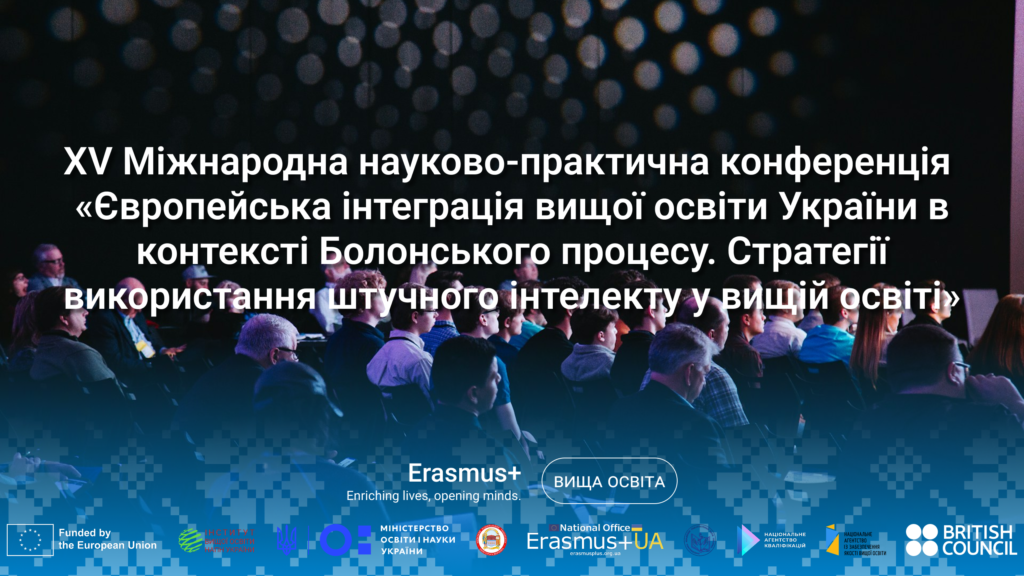
XV International Conference “European Integration of Ukraine’s Higher Education in the Context of the Bologna Process. Strategies for Using Artificial Intelligence in Higher Education” – TAM EVENT (10-11.11.2026, Kyiv, Ukraine)
On 10–11 November 2026, a TAM event comprising two events took place: the XV International Conference “European Integration of Ukraine’s Higher Education in the Context of the Bologna Process. Strategies for Using Artificial Intelligence in Higher Education” (the Bologna Conference), organised by the National Erasmus+ Office – Ukraine and the Erasmus+ Higher Education Reform Experts (HERE team – Ukraine), jointly with the Institute of Higher Education of the National Academy of Educational Sciences of Ukraine, Taras Shevchenko National University of Kyiv, the Ministry of Education and Science of Ukraine, the National Agency for Higher Education Quality Assurance, the National Qualifications Agency, the National Academy of Educational Sciences of Ukraine, and the British Council in Ukraine, with the support of the SPHERE consortium, the European Education and Culture Executive Agency (EACEA) and the European Commission’s Directorate-General for Education, Youth, Sport and Culture (DG EAC), and with the participation of TAM expert Professor Martin EBNER, Head of the Educational Technology Department at Graz University of Technology, Austria; and the workshop “Strategies for Using Artificial Intelligence in Higher Education Considering Ethical Issues and the Fundamental Values of the European Higher Education Area”.
The events brought together students, staff of higher education institutions and research institutions, representatives of professional pre-higher education institutions (VETIs), civil society organisations, the Ministry of Education and Science of Ukraine, the National Qualifications Agency, the National Agency for Higher Education Quality Assurance, and Erasmus+ Higher Education Reform Experts (HERE team).
On 10 November 2026, the Bologna Conference opened with welcome speeches and guidance from the event’s co-organisers.
Gyula CSEREY, Head of the Unit for International Cooperation, Cooperation, DG EAC, emphasised the importance of academic freedom and integrity when using AI tools,highlighted the relevance of the practical application of AI in teaching and learning, and expressed support for Ukraine, underlining the country’s progress in higher education reforming.
Minister of Education and Science of Ukraine Andriy BUTENKO emphasised the importance and relevance of the issues to be discussed during the Conference.
Mykola TROFYMENKO, Deputy Minister of Education and Science of Ukraine, stressed the need for digital competences in education in view of cyberattacks and the war situation. He highlighted the importance of the responsible and effective use of AI while safeguarding academic integrity and supporting Ukraine’s European integration efforts, the need for protection against cyber threats and the development of critical thinking skills. He also called for the development of practical recommendations for higher education and Ukrainian universities on the effective integration of AI and digital technologies.
Head of the National Qualifications Agency Yuriy BALANUK, joining from Brussels, announced an important recent development: Ukraine had successfully submitted its report on the referencing of the National Qualifications Framework to the European Qualifications Framework, making Ukraine the 39th country in the European Education Area to achieve this recognition.
Olena YEREMENKO, Deputy Head of the National Agency for Higher Education Quality Assurance, presented Ukraine’s achievements in the recognition of its national quality assurance system. Ukraine’s recent attainment of full membership in the European Association for Quality Assurance in Higher Education (ENQA) and the European Quality Assurance Register for Higher Education (EQAR) was highlighted as a significant step towards European integration.
Vasyl KREMEN, Honorary President of the National Academy of Educational Sciences of Ukraine, presented a wide range of the Academy’s current research on digitalisation and the introduction of AI in education, noting the need to apply its findings in the development of education policy and emphasising the importance of preserving critical thinking when using AI tools.
Valeriy KOPIIKA, Rector of Taras Shevchenko National University of Kyiv, stressed the importance of such joint events for discussing current issues and developing relevant proposals for Ukrainian universities.
Iryna DRACH, Director of the Institute of Higher Education of the National Academy of Educational Sciences of Ukraine, drew participants’ attention to a number of the Institute’s current studies, particularly those addressing digitalisation and AI in higher education. Open access to the research findings is available on the Institute’s website.
Svitlana SHYTIKOVA, Coordinator of the National Erasmus+ Office – Ukraine, noted, in particular, that Erasmus+ projects are aimed at supporting higher education reform in Ukraine in the context of European integration processes.
The Bologna Conference continued with presentations by speakers in accordance with the Programme.
In total, the Bologna Conference brought together 120 representatives of higher education institutions and research institutions from across Ukraine, including speakers, the National Erasmus+ Office – Ukraine and 10 HEREs – Ukraine..
On 11 November 2026, the workshop “Strategies for Using Artificial Intelligence in Higher Education Considering Ethical Issues and the Fundamental Values of the European Higher Education Area” included a discussion of the thematic issues addressed at the Bologna Conference and the development of framework recommendations on the use of AI in higher education as part of Ukraine’s digital development strategy.
The discussion focused on key issues, including how to ensure quality higher education while allowing the responsible use of AI, assessment methods for online learning, and the need to develop and apply pedagogical competences in the implementation of AI. Participants shared experiences from different institutions, including those specialising in maritime, medical and cybernetics-related areas, highlighting differences between these areas, as well as useful links.
Existing regulatory gaps in Ukrainian higher education legislation concerning digitalisation and AI were discussed, with participants noting that current documents contain no specific provisions on these technologies. Participants emphasised the need for methodological recommendations and digital competence frameworks for both academic staff and students. The importance of developing critical thinking skills and preventing AI from replacing students’ actual learning outcomes was also highlighted.
Representatives of higher education institutions and research institutions actively contributed to the discussion, including Iryna DRACH, Director of the Institute of Higher Education of the National Academy of Educational Sciences of Ukraine; Oleksii TKACHENKO, Associate Professor at the Department of Programming Theory and Technology, Faculty of Cybernetics, Taras Shevchenko National University of Kyiv; Maria NESTEROVA, Centre for European Studies of Social Innovations in Education, Mykhailo Drahomanov Ukrainian State University; Oleksii KALMYKOV, Head of the Medical Clusters Network; Zhanna TALANOVA, National Erasmus+ Office – Ukraine and Institute of Higher Education of the NAESU; and HEREs Volodymyr LUHOVYI, Yuriy RASHKEVYCH, Vadym ZAKHARCHENKO and Iryna SIKORSKA.
The discussion concluded with an agreement to systematise the outcomes and prepare framework recommendations for the Ministry of Education and Science of Ukraine, higher education institutions and research institutions, recognising the dynamic nature of AI development and the urgent need for targeted support for educators.
The workshop brought together 38 representatives of higher education institutions and research institutions, including 4 HEREs.
Certificates were awarded to Bologna Conference participants who had registered in advance, taken an active part in the event and confirmed their registration during the event.
Abstracts in English will be published free of charge in electronic format. Abstracts (if available) should be submitted by 18:00 on 18 November 2026 to the Organising Committee’s email address ([email protected]). File names must include the Conference participant’s surname and initials. The subject line of the email should contain the author’s surname and the session number (for example, “Shevchenko_section1”) (see the INFORMATION LETTER).
The Bologna Conference Proceedings will be published on the websites of the National Erasmus+ Office – Ukraine and the Institute of Higher Education of the NAESU following approval for publication by the Institute’s Academic Council and the assignment of an ISBN.
For further questions regarding abstracts, please contact Oksana VOROBIOVA, Senior Research Fellow at the Higher Education Quality Assurance Department, the Institute of Higher Education of the NAESU, at [email protected].
PRESENTATIONS:
- Oleh SHAROV, Maryna MRUGA, Ministry of Education and Science of Ukraine, HERE team
- Olena YEREMENKO, National Agency for Higher Education Quality Assurance
- Martin EBNER, TAM expert, SPHERE_1
- Yuriy RASHKEVYCH, HERE team
- Martin EBNER, TAM expert, SPHERE_2
- AFID – Ihor OLEKSIV, Lviv Polytechnic National University
- Re-Direction – Tetiana ODINTSOVA, Kyiv Medical University
- UkraineDigiTrans – Inna KUCHERENKO, O. Bohomolets National Medical University
- NEXT – Mykhailo LEBID, Odesa Polytechnic National University
- Kharkiv IT Cluster – Tetiana BOTSIAN
USEFUL LINKS:
- Post-Generative
- AI Competency Framework for Students
- A European Strategy for Artificial Intelligence in Science: Paving the Way for the Resource for AI Science in Europe (RAISE)
- Living Guidelines on the Responsible Use of Generative AI in Research
- Glossary of Artificial Intelligence Terms
- Recommendations on the Responsible Use of Artificial Intelligence Systems in Research
- “Living” Learning Materials in the Field of Health
RECOMMENDATIONS (under preparation)
Thank you. We believe in Ukraine, every citizen, the Armed Forces of Ukraine and our partners!
We support and work together towards victory! Ukraine was, is and will always be!
#ErasmusPlus #ErasmusUA #ErasmusGeneration #StandWithUkraine #ErasmusJointForcesUA